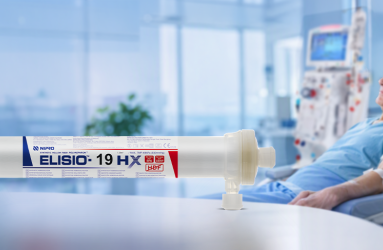
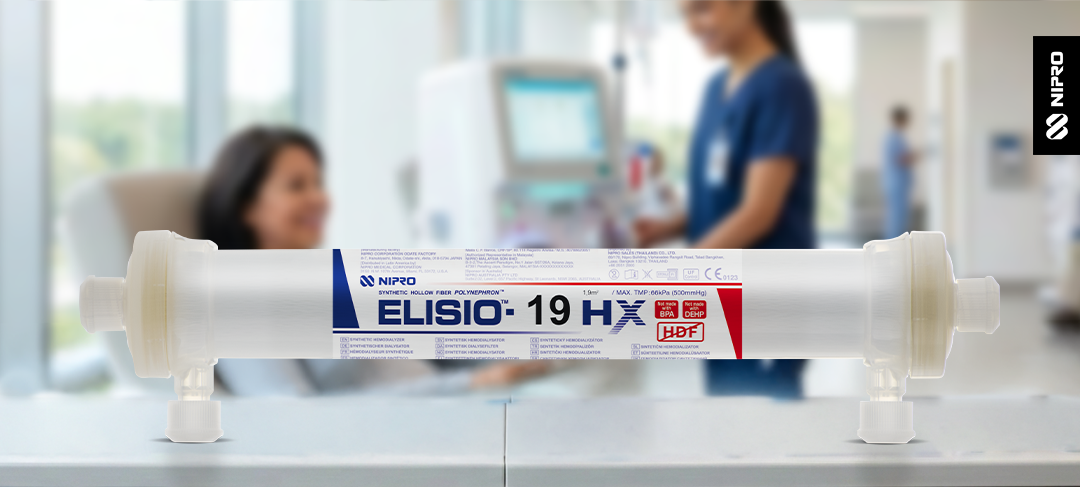
Now commercially available, the medium cut-off dialyzer expands access to enhanced middle molecule removal through existing dialysis infrastructure
OSAKA, Japan and BRIDGEWATER, N.J., – August 4, 2026 – NIPRO CORPORATION, through its U.S.-based subsidiary, NIPRO Medical Corporation, today announced the U.S. commercial launch of ELISIO-HX, a medium-cutoff dialyzer featuring super high-flux membrane technology. Enabled by the recent U.S. Food and Drug Administration (FDA) 510(k) clearance of ELISIO-HX, NIPRO is introducing its Expanded hemodialysis approach with a super high-flux membrane, or HDs in short, to dialysis providers nationwide. The launch of ELISIO-HX represents an important milestone in kidney care and reflects NIPRO’s commitment to making advanced dialysis technologies more accessible to dialysis providers and patients across the country.
A Scalable Path to Enhanced Middle Molecule Removal
For years, dialysis providers have sought ways to expand the removal of larger middle molecules, substances associated with inflammation and other complications that are not effectively cleared by conventional high-flux dialysis. Until now, broader adoption of therapies designed to address this challenge has been limited due to supply constraints, high costs, operational complexity, and infrastructure requirements.
With the introduction of ELISIO-HX, U.S. providers now have access to an expanded hemodialysis therapy with a strong global track record and robust supply capabilities that enhances middle molecule removal. The membrane incorporates a highly controlled and precisely engineered pore structure that is designed to extend the removal profile of larger middle molecules while maintaining albumin retention, an important consideration in preserving patients’ nutritional status.
Since ELISIO-HX is compatible with existing hemodialysis infrastructure, physicians and providers can incorporate expanded hemodialysis into routine clinical practice without purchasing new machines, fundamentally changing treatment workflows, or retraining staff.
Providers have sought a scalable way to improve middle molecule clearance, but supply constraints, operational complexity and infrastructure requirements have impacted adoption rates in the U.S.
The ELISIO-HX is designed to help overcome those barriers, making this approach accessible through existing dialysis delivery models and at a scale that has not previously been possible.
More Patients Without More Exclusions
Unlike some therapies that may require higher blood flow rates or more complex treatment conditions, expanded hemodialysis with ELISIO-HX may be suitable for a broader range of patients, including those with vascular access limitations or other considerations that can make high-volume therapies more challenging to deliver.
This practical implementation profile supports broader adoption across diverse dialysis populations and care settings. With limited patient eligibility restrictions, this practical approach has the potential to efficiently make enhanced middle molecule removal available to significantly more patients.
Designed for Clinical Practice
As dialysis providers continue to seek innovations that improve care while maintaining operational efficiency, implementation remains a key consideration. Providers can evaluate and implement expanded hemodialysis within existing treatment schedules, staffing models, and equipment environments.
Every advancement in dialysis should be measured by its potential to improve the patient experience.
The availability of ELISIO-HX expands the range of treatment options available to nephrologists and the patients they care for, bringing an important innovation into routine practice. More choice enables more individualized care, and that's ultimately what patients deserve.
Global Experience, U.S. Availability
The U.S. introduction builds on NIPRO’s global experience with ELISIO-HX across Asia, Europe, and Latin America, where the technology has been used in a variety of healthcare settings. This international experience, combined with a robust global supply chain, enables NIPRO to bring ELISIO-HX to market in a scalable, value-oriented, and timely manner.
The launch of ELISIO-HX expands treatment options for U.S. providers seeking enhanced middle molecule removal while using existing hemodialysis infrastructure. Now commercially available, NIPRO is supporting the delivery of care that helps people live longer and better lives.
About NIPRO
NIPRO is a global healthcare company committed to improving patient outcomes through innovative medical technologies, pharmaceutical solutions, PharmaPackaging, and regenerative medicine. Guided by its promise of helping people live longer and better lives, NIPRO partners with healthcare professionals around the world to deliver safe, reliable and practical solutions that advance patient care.
Media Contacts
Annick Somers | NIPRO Global Marketing & Communications
[email protected]
David Reese | NIPRO Americas Marketing & Communications
[email protected]
Expanded Hemodialysis
Discover how ELISIO™-HX supports expanded hemodialysis with a practical approach designed for everyday clinical use.

Frequently Asked Questions (FAQs)
The commercial availability of the ELISIO-HX will have a broad impact on the U.S. dialysis industry, specifically for dialysis providers, physicians, and patients:
1.1. Impact for dialysis providers: Historically, broader access in the U.S. to therapies that enhance middle molecule removal has been limited by supply, resource constraints, and operational challenges. ELISIO-HX helps address these barriers by providing U.S. providers with access to an expanded hemodialysis therapy supported by proven global experience and a reliable supply infrastructure, enabling more patients to benefit from this treatment approach.
1.2. Impact for physicians: ELISIO-HX represents an important advancement in dialysis care by expanding the treatment options available to nephrologists. With greater flexibility to tailor therapy to individual patient needs, ELISIO-HX supports a more personalized approach to care, helping physicians optimize treatment for people living with kidney disease.
1.3. Impact for patients: Every patient is unique, and their dialysis treatment should reflect that. ELISIO-HX expands the options available for treatment, enabling more personalized treatment decisions that help optimize care for patients with kidney disease.
Since ELISIO-HX is the engine for middle molecule clearance and works within conventional HD treatment infrastructure and schedules, the patient can benefit from improved outcomes without having to change their daily routine.
ELISIO-HX is NIPRO’s proprietary super High-Flux dialyzer and the technology behind HDs: Hemodialysis powered by super high-flux membrane. It is designed to extend the removal of larger middle molecule uremic toxins beyond conventional high-flux hemodialysis while maintaining albumin retention.
ELISIO-HX is built on the Polynephron™ membrane, a precisely engineered sharp cut-off polyethersulfone membrane. It removes a broad range of middle molecules, including beta-2 microglobulin, free light chains and myoglobin, while limiting albumin loss to less than 1 gram per treatment session.
In Japan, ELISIO-HX belongs to the Class V super high-flux category. Clinical study data covering more than 200,000 patients have associated Class V dialyzers with statistically significant reductions in all-cause mortality risk compared with Class IV dialyzers.
HDs stands for Expanded Hemodialysis powered by super high-flux membrane. The “s” refers to super high-flux, the advanced membrane category that enables the treatment performance of HDs.
HDs is NIPRO’s approach within Expanded HD. It uses the ELISIO-HX super high-flux dialyzer and NIPRO’s proprietary membrane technology to extend the removal of larger middle molecules beyond conventional high-flux dialysis while maintaining albumin retention.
The concept is deliberately simple: enhanced dialysis performance is delivered through the membrane itself, without requiring a new treatment platform, specialized equipment or fundamental changes to established hemodialysis workflows.
Super high-flux describes a class of dialysis membrane engineered to remove a broader range of middle molecules than conventional high-flux membranes.
Our specific membrane has a precisely controlled pore structure that extends the removal of larger middle molecules, particularly those in the approximately 12 to 60 kDa range, while maintaining controlled albumin loss.
In Japan, super high-flux dialyzers are designated Class V. Elisio™ HX belongs to this category.
Larger middle molecules have been associated with inflammation, cardiovascular complications, and other adverse effects in people with kidney disease. Enhancing the removal of these molecules may help nephrologists more closely replicate the natural filtration function of healthy kidneys as part of dialysis therapy.
ELISIO-HX combines enhanced middle molecule clearance with a sharp cut-off membrane technology. Three characteristics distinguish ELISIO-HX in the U.S. market:
6.1. Sharp cut-off membrane design
The Polynephron™ membrane delivers broad middle molecule removal while limiting albumin loss to less than 1 gram per treatment session.
6.2. Broad patient eligibility
Approximately 95% of hemodialysis patients are eligible for treatment with ELISIO-HX, including patients who may be unable to receive HDF because of vascular, clinical or volume-related constraints.
6.3. Infrastructure compatibility
ELISIO-HX is compatible with existing hemodialysis systems and requires no new dialysis equipment, specialized infrastructure or additional capital investment. Together, these characteristics make HDs both clinically differentiated and operationally scalable.
Albumin retention is an important consideration when evaluating dialyzer performance. Within the ELISIO-HX, the sharp cut-off design of the Polynephron™ membrane maintains an albumin sieving coefficient of 0.0024 and limits albumin loss to less than 1 gram per treatment session. This enables ELISIO-HX to extend middle molecule removal while maintaining controlled albumin loss.
ELISIO-HX has been used clinically across Asia, Europe and Latin America and has been integrated into routine dialysis care across a range of healthcare settings. This broad clinical experience provides an important foundation for the introduction of ELISIO-HX and HDs in the United States.
It also demonstrates that the treatment approach can be incorporated into existing dialysis infrastructure and workflows across diverse healthcare systems.
Yes. The ELISIO-HX is fully compatible with conventional hemodialysis machines and established clinical workflows.
It requires no new equipment, no specialized treatment platform and no fundamental changes to dialysis delivery protocols. This is a defining characteristic of HDs.
The enhanced treatment performance comes from the membrane inside the dialyzer, rather than from additional infrastructure. Providers can therefore introduce HDs within the systems and workflows they already use.
While each patient’s treatment should be driven by their individual needs and validated by their nephrologist, the ELISIO-HX was designed for broad patient eligibility in the removal of larger middle molecules.
A vast majority of current conventional HD patients can benefit from treatment through the ELISIO-HX, with the only exception being the small percentage of patients that have allergies or sensitives to synthetic dialyzer membranes.
Both HDs and on-line HDF aim to extend the removal of middle molecules beyond conventional high-flux hemodialysis. The main difference lies in how that performance is achieved.
On-line HDF depends on specialized equipment, convective replacement fluid and specific operational protocols. HDs achieves enhanced middle molecule removal through the super high-flux membrane in the ELISIO-HX dialyzer.
As a result, HDs operates within standard hemodialysis practice and does not require convective replacement fluid, specialized HDF equipment or fundamental workflow changes. This makes HDs accessible to a broader patient population and easier to implement across existing dialysis networks.