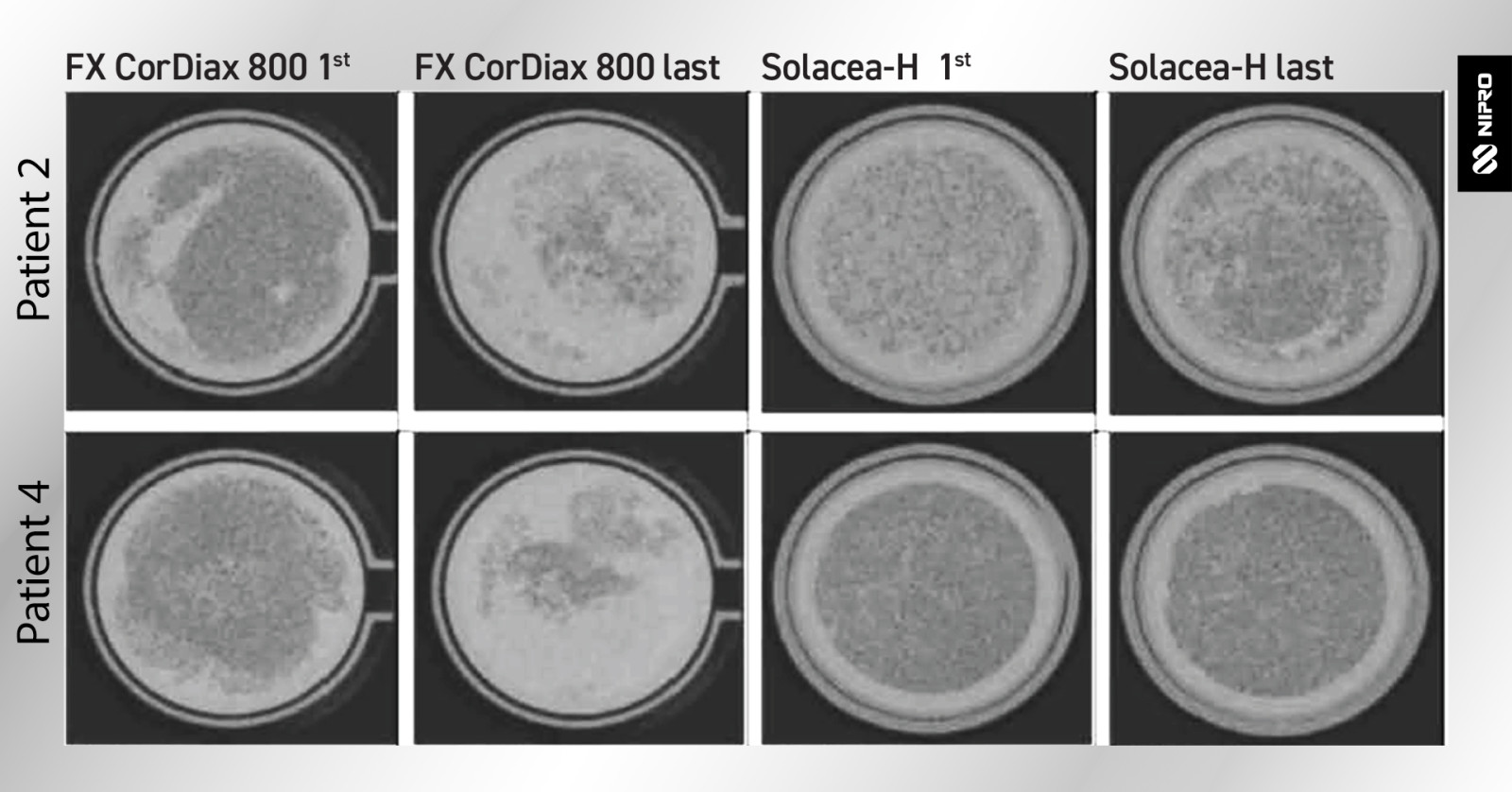
Membrane fiber patency: Above are reconstructed images of the dialyzer cross-sections (micro-CT) for the 1st sessions, at full heparin dose, and the Last sessions, at reduced heparin dose, of two patients. Black dots represent open fibers. In the last session, SOLACEA-H displays a significantly higher proportion of open fibers than the FX CorDiax™ 800.
NIPRO’s SOLACEA™-H dialyzer was featured in a study comparing its ATA™ membrane against standard synthetic membranes. The study progressively tapered off the dosage of systemic anticoagulation (heparin) in post-dilution, high-volume online HDF to observe the thrombogenic effects of reduced heparin use in standard synthetic membranes (FX CorDiax™ 800 and Polyflux™ H) versus the ATA membrane of SOLACEA-H.
"Our findings suggest that the asymmetric cellulose triacetate membrane may be useful in situations where it is important either to perform the dialysis session without heparin or to reduce heparin dosage while maintaining the effectiveness of dialysis." (Puerta, et al., 2025)
Significance of the SOLFA Study
Heparin is used in dialysis sessions to prevent the patient’s blood from clotting inside the dialyzer or the dialysis circuit (Claudel et al., 2020). However, heparin is not recommended in patients with allergies or heparin-induced thrombopenia (Sahota & Rodby, 2014). Unrestricted use of heparin can lead to patient vascular access bleeding and cerebral, retinal, and/or gastrointestinal hemorrhage (Herrero-Calvo et al., 2012). Treatment without heparin is not optimal, however, and more effective methods for preventing clotting in the circuit are needed.
Key Findings from the SOLFA Study
The SOLFA study (Puerta et al., 2025), published in the Journal of Nephrology, was a prospective, multicenter, crossover, open-label, randomized study to investigate the impact of Solacea’s ATA membrane versus synthetic dialyzers on the thrombogenicity of the dialysis circuit in online HDF.
Impact on Dialysis Efficiency and Heparin Reduction
“For sessions with the lowest heparin dose, the results of the ATA™ membrane were more favorable in all cases.”
"Dialyzer efficacy was not significantly affected by heparin reduction or the type of dialyzer."
- Post-dialysis myoglobin values were lower with the ATA™ membrane (45 + 12.7 ng/mL) compared to the synthetics (45 ng/mL vs 90 + 33.9 ng/mL) (p=0.003)
- The heparin reduction did not adversely affect dialysis efficiency, as measured by Kt or the convective volume achieved in patients treated with HDF
- The number of dialysis sessions completed with a reduced heparin dose, or without heparin, was higher with the ATA™ membrane compared to synthetic
- Of the sessions completed without heparin, 60% used Solacea™-H versus 24% using a standard synthetic membrane. (p =0.02)
- In the final session, patients dialyzed with the ATA™ membrane received 43.8% of their usual heparin dose, whereas those with synthetic membranes received 75% of their usual dose.
- The number of sessions performed with a reduction in heparin dose differed significantly: 46% with the ATA membrane vs 7% with the synthetic membrane (p=0.01)
Clotting and Fiber Patency
"The ATA™ membrane demonstrates superior antithrombotic properties as compared with synthetic membranes."
"The proportion of open fibers post-dialysis was greater with the ATA™ membrane (Solacea™-21H) than with synthetic membranes (FXCorDiax800 and Polyflux 210H)."
- Visual scoring and micro-CT analysis determined that the ATA™ membrane had a lower number of clotted fibers compared to synthetic membranes
- A high visual coagulation score (3 -4) was obtained in only 18% of sessions with the ATA™ membrane compared to 60.7% with the synthetic membrane (p = 0.04)
- The ATA™ membrane maintained a similar range of open fibers between the first and last session, while for the FXCorDiax800 membranes, the number of open fibers was significantly lower in the last session (p=0.02 at 50%; p = 0.02 at 70%; p = 0.02 at 90%)
- The proportion of open fibers post-dialysis was significantly greater with the ATA™ membrane than with synthetic membranes under microCT scan
The SOLFA study is available for open access at the link below.
Puerta, Jaldo, Muñoz, et al. (2025). SOLFA study: a multicenter, open-label, prospective, randomized study to investigate the clotting propensity of asymmetric cellulose triacetate membrane compared to synthetic membranes in online HDF. https://doi.org/10.1007/s40620-024-02197-y
Discover more about ATA™, NIPRO’s asymmetric, semi-natural membrane, at the SOLACEA product page.
Frequently Asked Questions
The ATA™ membrane features a unique asymmetric cellulose triacetate structure with smoother surfaces and antithrombotic and hypoallergenic properties, unlike standard synthetic membranes. The ATA membrane’s antithrombotic properties can be attributed to its chemical structure and smoother surface, according to the authors, which provides it with electrostatic properties that reduce protein adsorption.
Yes. According to the SOLFA study, several patients successfully underwent heparin-free dialysis with ATA™, showing fewer clotting issues compared to synthetic alternatives.
No. The study found no significant differences in key performance indicators, such as Kt or convective volume, even with reduced heparin.
Patients with contraindications to heparin, such as those with heparin-induced thrombocytopenia, may benefit significantly from Solacea™-H ATA™.
Potentially, yes. By reducing the need for heparin and preventing clot-related session failures, ATA™ can lead to cost savings and better patient outcomes.
Solacea™-H ATA™ is available in many markets. Contact your regional distributor for specific availability.